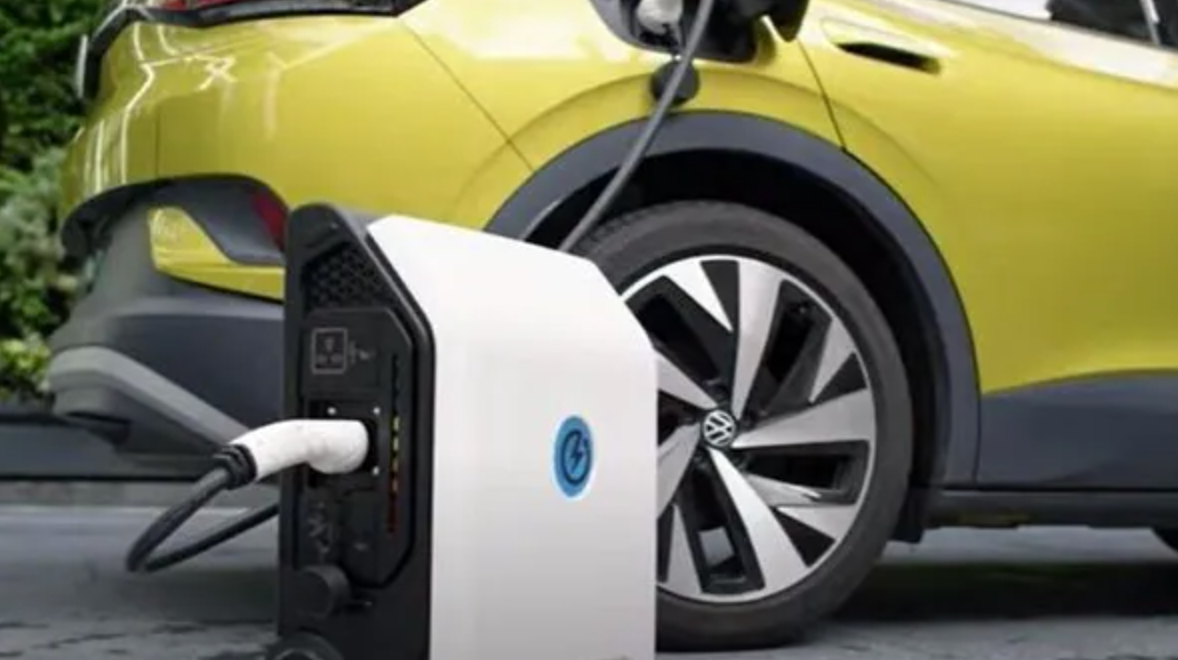

Charging equipment for EVs is classified by the rate at which the batteries are charged. Charging times vary based on how depleted the battery is (i.e., state-of-charge), how much energy it holds (i.e., capacity), the type of battery, the vehicle’s internal charger capacity, and the type of charging equipment (e.g., charging level, charger power output, and electrical service specifications).
Buying the Tesla Charge Adapters From here>>>www.indepot.online/shop/ccs1-to-tesla-charger-adapter-1000v-250kw/
The charging time can range from less than 20 minutes using DC fast chargers to 20 hours or more using Level 1 chargers, depending on these and other factors. When choosing equipment for a specific application, many factors, such as networking, payment capabilities, and operation and maintenance, should be considered.
Level 1 Charging, Approximately 5 miles of range per 1 hour of charging*
J1772 connector
Alternating Current (AC) Level 1 equipment (often referred to simply as Level 1) provides charging through a 120 volt (V) AC plug. Most, if not all, EVs will come with a portable Level 1 cordset, so no additional charging equipment is required. On one end of the cord is a standard NEMA connector (for example, a NEMA 5-15, which is a common three-prong household plug), and on the other end is an SAE J1772 standard connector (often referred to simply as J1772, shown in the above image). The J1772 connector plugs into the car’s J1772 charge port, and the NEMA connector plugs into a standard NEMA wall outlet.
Level 1 charging is typically used when there is only a 120 V outlet available, such as while charging at home, but can easily provide charging for most of a driver’s needs. For example, 8 hours of charging at 120 V can replenish about 40 miles of electric range for a mid-size EV. As of 2022, less than 1% of public EV charging ports in the United States were Level 1.
Buying the Tesla Charger Adapters and Type 1 to Type 1 EV Adapters From here>>>www.indepot.online/product/electric-vehicle-parts/ev-charging-plugs
Level 2 Charging, Approximately 25 miles of range per 1 hour of charging
J1772 connector / J3400 (NACS) connector
AC Level 2 equipment (often referred to simply as Level 2) offers charging through 240 V (typical in residential applications) or 208 V (typical in commercial applications) electrical service. Most homes have 240 V service available, and because Level 2 equipment can charge a typical EV battery overnight, EV owners commonly install it for home charging. Level 2 equipment is also commonly used for public and workplace charging and can operate at 40 to 80 amperes (Amp). Most residential Level 2 chargers operate at up to 30 Amps, delivering 7.2 kW of power. These units require a dedicated 40-Amp circuit to comply with the National Electric Code requirements in Article 625. As of 2022, nearly 80% of public EV charging ports in the United States were Level 2.
Level 2 charging equipment uses the same J1772 connector that Level 1 equipment uses. All commercially available EVs in the United States have the ability to charge using Level 1 and Level 2 charging equipment.
Vehicles with a J3400 (also referred to as NACS, or North American Charging Standard) connector (currently only Tesla vehicles) can use the connector for all charging levels, including Tesla’s Level 2 Destination Chargers and chargers for home. All Tesla vehicles come with a J1772 adapter, which allows them to use non-Tesla Level 2 charging equipment.
Level 3 DC Fast Charging, Approximately 100 to 200+ miles of range per 30 minutes of charging
CCS connector / CHAdeMO connector / J3400 (NACS) connector
Direct-current (DC) fast charging equipment (typically a three-phase AC input) enables rapid charging along heavy traffic corridors at installed stations. As of 2022, more than 20% of public EV charging ports in the United States were DC fast chargers. The availability of DC fast charging is expected to increase as a result of federal funding to build a national EV charging network, such as the National Electric Vehicle Infrastructure Formula Program or national Alternative Fuel Corridors grant program. Additionally, DC fast charging is projected to increase due to fleets adopting medium- and heavy-duty EVs (e.g., commercial trucks and vans and transit), as well as the installation of fast charging hubs for transportation network companies (e.g., Uber and Lyft) and other applications.
There are three types of DC fast charging systems, depending on the type of charge port on the vehicle: SAE Combined Charging System (CCS), CHAdeMO, and J3400.
Buying the Tesla Charger Adapters and Type 1 to Type 1 EV Adapters From here>>> www.indepot.online/shop/type-1-to-type-2-adapter-250v-32amp-ev-car-plug/
The CCS connector (also known as SAE J1772 combo) lets drivers use the same charge port with AC Level 1, Level 2, and DC fast charging equipment. The only difference is that the DC fast charging connector has two additional bottom pins. Most EV models on the market can charge using the CCS connector.
The CHAdeMO connector is another common DC fast connector type among Japanese automakers.
SAE International is standardizing the J3400 connector based on Tesla’s design for the NACS connector, which works for all charging levels, including Tesla’s fast charging option, called a Supercharger. Although Tesla vehicles do not have a CCS or CHAdeMO charge port, they come with a limited CCS or CHAdeMO adapter that supports charging up to 19.2 kW. Tesla does sell full power adapters for both connector types. Several vehicle manufacturers have announced adopting the J3400 connector as early as 2025, which will allow non-Tesla EVs to charge at Tesla stations with the J3400 connector.
EV Charging Plugs – IN Depot-leading international factory-authorized OEM and ODM distributor for a select group of prominent manufacturers of Electric Vehicle Charging equipments, Electric Vehicle aftersale spare parts, EV Power Bank Chargers, Home and Office Power Banks, Security Video Surveillance Equipments